I quickly emailed Kathy to see if she and Bill would be in Santa Fe. She immediately wrote back and said that they would be and had signed up for a tour of Los Alamos the day after we arrived, July 16, the 70th anniversary of the Trinity Test. She invited me to come along and mailed a brochure. I found a link that describes Los Alamos and much more. The tour was arranged for members of the Palace Guard. Of course, given my investigations of organizations with interesting names in connection with my family's genealogy (I am eligible through my mother's line to be a member of the Ancient and Honorable Artillery Company - they call themselves the Ancient and Honorables), I was intrigued by the name of the group and so went to Google to find out more. Ultimately, not only did I sign up for the tour, Enrique and I also became supporters of the Museum of New Mexico Foundation as well as members of the Palace Guard, the Foundation's support group.
Enrique would be in meetings on Thursday and Friday, so in addition to the tour, Kathy and I planned to spend time together on Friday including dinner for all of us on Friday night. Saturday I hoped, weather permitting, to drive the High Road to Taos (this link is quite informative and I recommend you take a look and make note of the routes to take for because some of the routes can be confusing) with Enrique as well as take a detour to see the now famous bridge over the Rio Grande Gorge and if we still had time, to visit the Taos Pueblo. We "lost" Wednesday and Sunday of our trip because Southwest dropped the wonderful flight between Tucson and Albuquerque; consequently, we flew through Phoenix. Last time we flew through Las Vegas, Nevada. We agreed that if/when we make this trip again, we will either drive over to Santa Fe (8 hours, 511 miles) and return through Winslow as a side trip or drive to Phoenix and catch a Southwest Airlines flight from there. Too much time is lost sitting in airports, waiting for flight connections.
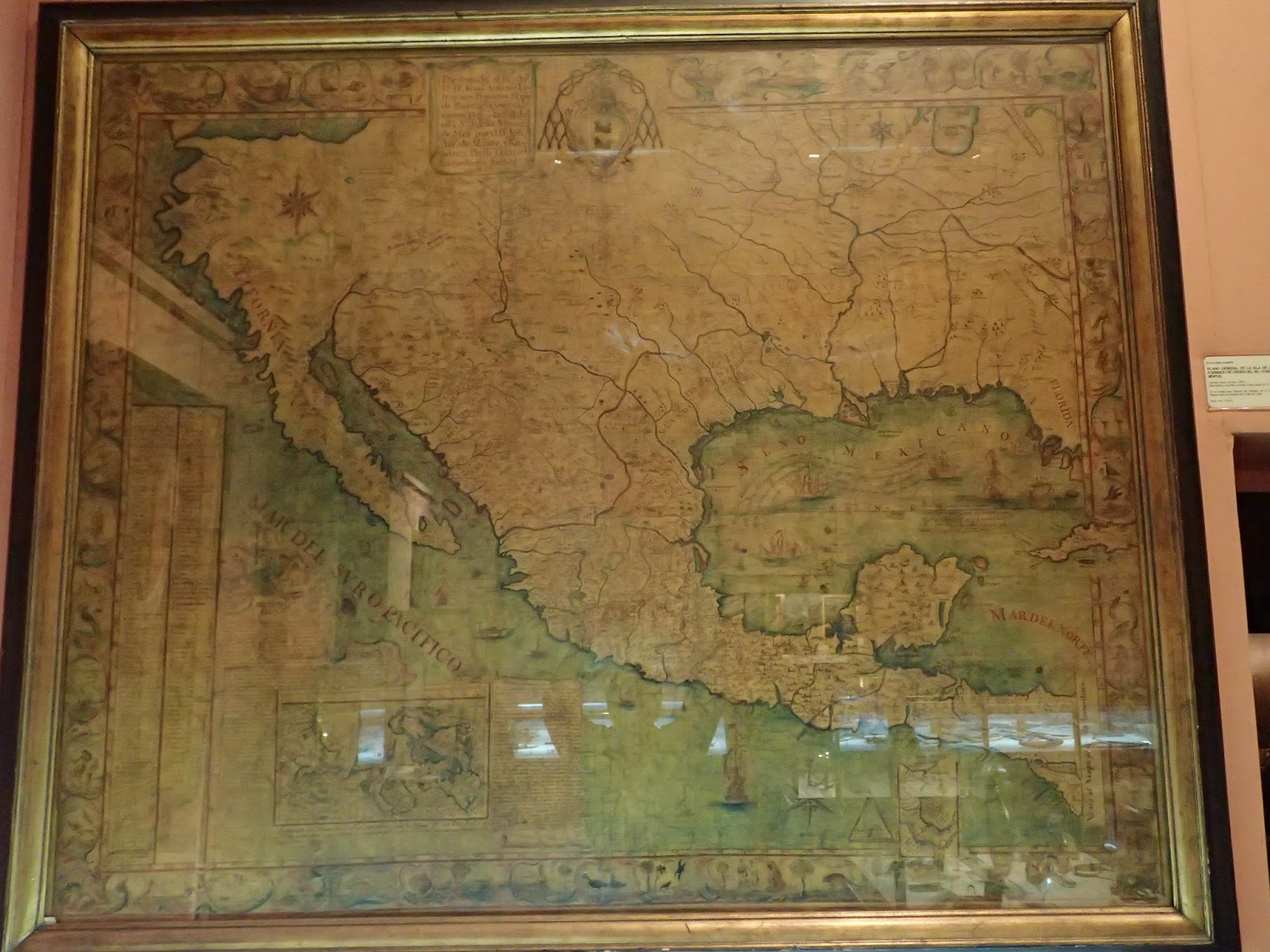
A few words about maps: Our favorite map - The 2008 The Origina Santa Fe and Canyon Road Walking Map was provided to us by our hotel in 2008: The Inn of the Anasazi. However, the Hotel Santa Fe wasn't on it. I found an updated version and encourage you to take a look. Another map, also provided by the Inn of the Anasazi is this one:

and this part:

Here's a link to another map of the Plaza area. Scroll down to view it.
We've been delighted to learn that walking around Santa Fe is quite easy and convenient. We've yet to explore the Santa Fe Rail Yard Arts District - another map.
If you like to walk, be sure to take the Downtown Walking Tour offered by the Palace of the Governors. We enjoyed this guided tour during our first visit to Santa Fe and have returned to several sites. The tours begin in front of the Blue Gate south of the New Mexico History Museum's main entrance at 113 Lincoln Avenue. For more information, go here.
Our home base and the location of the C-Path/CDISC meetings was the Hotel Santa Fe, a joint venture between the Picuris Pueblo and a group of Santa Fe-based business people. The hotel provides a brochure about the history of the Picuris and the hotel. Here's a link to some information that illustrates how the hotel benefits the Picuris. The hotel is surrounded by wildflower gardens and is designed based on a multi-level, terraced adobe pueblo. We enjoyed breakfast the first morning, a lunch on Friday (Jen), and two dinners at the hotel's Amaya Restaurant, one of the best in Santa Fe. More about our Saturday evening dinner later.
Thursday morning, Enrique went downstairs for his meeting while I met Kathy and Bill at the hotel entrance. We drove to Los Alamos and the Fuller Lodge for our 10 o'clock start.


Following our tour of the Lodge and an introduction to the history of the Lodge - formerly The Ranch, an elite boy's school - and the Manhattan Project beginnings, we enjoyed a walking history tour and also learned through early photos what the area looked like in the 1930's and 40's. Much of the information presented, including a map of the grounds, can be found in the books, 109 East Palace by Jennet Conant and Dorothy Scarrit McKibbin: Gatekeeper to Los Alamos by Nancy Cook Steeper. Imagine the pond (photo below) as a simple depression in the land as it was during the time of the school. The boys would ice skate during the winter and canoe during the summer. Notice the photo of the boys. They wore those shorts and high socks year round no matter what the temperature.


Shortly after noon we gathered at one of the former Manhattan Project homes for lunch and presentations. The home is located on historic Bathtub Row (find out more at the link below to the Los Alamos Historical Society) and occupants included first, Edwin McMillian, and second Hans Bethe. Ellen Bradbury Reid talked about her early life at Los Alamos during the Manhattan Project era. Her father, Edward Wilder, worked at Los Alamos. Heather McClenahan, who is currently the executive director of the Los Alamos Historical Society, provided additional information about Los Alamos and its history as did others who had joined the tour. Afterwards we were invited to watch a film featuring interviews with several of the people who worked on the Manhattan Project. Their comments revealed their mixed reactions to viewing the detonation of the test bomb explosion at Trinity on July 16, 1945. You can learn more about this Atomic Heritage Foundation project here.


 |
| The home of Robert Oppenheimer |
We returned to Santa Fe midafternoon and spent time together at Bill and Kathy's beautiful restored adobe historic casita before Kathy returned me to the hotel to join Enrique and his colleagues for dinner.
We all walked to Casa Chimayo for classic New Mexican cooking including blue corn enchiladas - our second foodie stop, the Amaya being the first. The hotel Santa Fe provides each guest with a comprehensive guide of all the restaurants in the area (82 - so we've barely scratched the surface) that notes, "...The owners of Casa Chimayo trace their roots back to the 1500's and the families that settled in the mountains of Northern New Mexico - Chimayo, Truchas, Penasco....."
Friday morning Enrique and I walked across the street to breakfast at the Sage Bakehouse that is renowned for its homemade bread and sandwiches. I enjoyed the scrambled eggs on toast. The linked site has several photos for you to enjoy.
Afterwards, he went back to the hotel for meetings while I joined Kathy who suggested rather than hike that we drive to the Pecos National Historical Park where we were treated to an outstanding and comprehensive tour led by Jamie Samana, one of the Park Rangers and also a college professor of Geography. Rather than go into great detail about what we learned, here's an informative link about the Park. A young boy and his parents were part of our tour group and Jamie provided him with lots to see and do along the way including climbing down into an impressive restored kiva, the first I'd ever explored.


 |
| Jamie lined up the pot pieces and described each one |

 |
| Inside the Kiva |

Following the tour and our return to Santa Fe, Kathy went on to an appointment while I enjoyed a late lunch with Enrique followed by a welcome nap.
Friday evening we walked to the Santa Fe Plaza (featured in photos in accounts of our earlier visits) and discovered a wonderful collection of cars - both antique and modern - parked all around the four sides of the central Plaza. Enrique was delighted. We took several photos before ambling on to join Kathy and Bill at La Casa Sena at 125 East Palace, just up the street from 109 East Palace where some passersby took our photo. Our dinner was absolutely delicious. Another must for foodies. A wonderful evening and outdoor dining. We appreciated the long stroll back to our hotel later that evening.


When we were last in Santa Fe, we drove the "Low Road to Taos." This time, following breakfast at the very popular (a line forms before the 8 a.m. opening time) Cafe Pasqual that offers authentic delicious New Mexican food), we took the High Road, a scenic byway along very narrow two lane roads, many of which hairpinned up and down into villages and through pueblos. The weather was perfect for we looked at beautiful vistas in all directions. Although we were high, the mountains including the Truchas Peaks and Taos Mountains with Wheeler Peak at 13,161 feet (New Mexico's highest) towered over us or off in the distance. Taos is a popular winter skiing area.
Along the way (NM 503, NM 520) we visited the Pueblo of Nambe (Tewa), Chimayo with its beautiful Sanctuario de Chimayo known for El Posito, a hole in the floor of the side chapel filled with healing earth. One can purchase in the nearby gift shop or bring a container to take away some of the earth. Serendipitously, our arrival at 10:45 coincided with Mass at 11 am, so we decided to stay. We then climbed along NM 76 and dropped into Cordova before heading on to Truchas and beyond that to the village of Las Trampas. The 18th century church in Las Trampas was in sad disrepair and was not open so we could not go inside to see the original paintings written about in various accounts.


 |
| A representative pilgrim |


At NM 76/75 we took the one-half mile detour to Picuris Pueblo and its unadorned adobe church, dating from the 1770's. From there we drove back south on NM 75 to NM 518 for incredible views of Carson Forest and the Taos Mountains. We proceeded through the villages of Talpa and Ranchos de Taos and bypassed, through side streets, Taos this time (the traffic inches along into Taos all day) and headed west via US84 past the Taos Airport (closed weekends) to the Rio Grande Gorge Bridge.


The engineering of the steel bridge is amazing. We lingered there for awhile but realized if we were to take in the Taos Pueblo, a national historic landmark, before it closed, we needed to get there quickly. We joined the last guided tour of the day and learned quite a bit from our guide, a young man who lives in the vicinity of the Pueblo. Here's a link with comprehensive information.


At this point, we both were very tired and keen to return to Santa Fe, dinner, and sleep. Upon arrival back at the hotel, we went straight to dinner at Amaya again but this time we not only enjoyed another delicious meal in their dining room that is glassed in during the winter and open to the elements at other times during the year, but also the music provided by Ronald Roybal, a Native American flute and guitar musician. His website will introduce you to him playing his flute and guitar. The music is available for purchase. An enchanted evening in the Land of Enchantment....
Next morning we hurried back to Cafe Pasqual's. This time I enjoyed the huevos rancheros, served in a bowl like a stew while Enrique feasted on their amazing chorizo burrito. Then off we headed back to Albuquerque and our (long - delays and rebookings) trip back to Tucson. We were happy to be home and Guido was very happy to see us.
As a postscript, in previous trips we enjoyed dinner at 315 Restaurant and Wine Bar, La Boca, and Mucho Gusto and one other that has since closed, unfortunately. Obviously, with 82 restaurants nearby, we'll need to branch out next time.
Separate thought re Los Alamos:
[In closing, as you might imagine, the tour of Los Alamos provided moments of sober reflection. I do recall being one of several guests at a dinner many, many years ago hosted by MIT Professor Philip Morrison and his wife. Professor Morrison voiced mixed feelings about his role in the Manhattan Project. Particularly shocking to me, as well, was learning thanks to the piece in the on line Saturday, July 19, 2015 edition of the Santa Fe New Mexican [Title: 70 Years after Trinity, nuclear weapons enterprise prospers in New Mexico by Len Ackland and Burt Hubbard], that the Sandia National Laboratories has been working on the sophisticated B61-12, a nuclear bomb that will potentially have a maximum explosive force equivalent to 50,000 tons of TNT - more than three times more powerful than the bomb dropped on Hiroshima, Japan. I was also startled to read within the article, "High on the list of aircraft that could carry the bomb is Lockheed's new F-35 fighter jet", a stealth fighter jet." The F-35 jet has been plagued by technical problems and cost overruns. Have we learned anything from our country's recent past? I certainly hope wiser minds will prevail.]